.png)

May 25, 2026
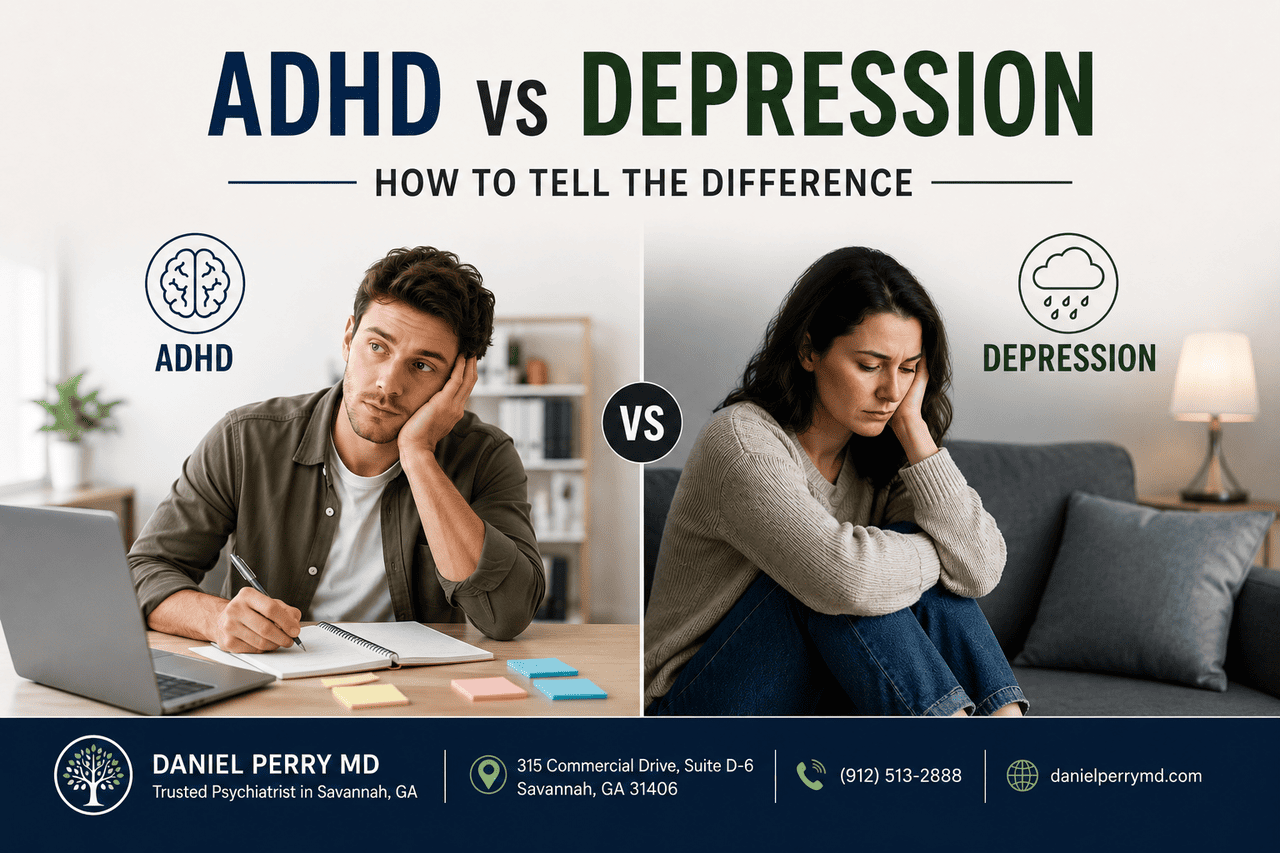
Difficulty concentrating, low motivation, forgetfulness, mental fatigue, and emotional overwhelm can all point to different mental health conditions. This is one reason many adults struggle to determine whether they may have ADHD, depression, or both.
Because symptoms often overlap, ADHD and depression are commonly confused or misdiagnosed.
At Daniel Perry MD, a trusted psychiatrist in Savannah GA, comprehensive psychiatric evaluations help patients understand the underlying cause of their symptoms and identify the most effective treatment approach.
Let’s break down the difference between ADHD and depression in adults.
Yes.
Both ADHD and depression can cause:
However, the reason these symptoms occur is very different.
Understanding the root cause is essential because treatment approaches are not the same.
Attention-Deficit/Hyperactivity Disorder (ADHD) is a neurodevelopmental condition that affects executive functioning.
Executive functions include:
Adults with ADHD often describe feeling mentally scattered or constantly overwhelmed by responsibilities.
You can learn more about
👉 ADHD in adults
and how symptoms affect daily life.
Depression is a mood disorder that affects emotional state, energy, motivation, and overall functioning.
It involves more than sadness and can impact:
Some individuals with depression continue functioning outwardly while struggling internally, sometimes referred to as
👉 high-functioning depression.
With ADHD, tasks are often difficult because of:
With depression, motivation problems are usually tied to:
Adults with ADHD may want to complete tasks but struggle to organize themselves enough to begin.
Adults with depression may feel emotionally disconnected from tasks altogether.
ADHD often creates frustration from chronic disorganization and underperformance.
Depression is more likely to involve:
Understanding
👉 signs of depression in adults
can help clarify whether mood symptoms are primary.
ADHD symptoms typically begin earlier in life, even if they were not diagnosed during childhood.
Depression may develop later and may be triggered by:
Both conditions affect concentration, but differently.
Adults frequently searching for
👉 ADHD testing near me
are often trying to understand this exact distinction.
ADHD may involve:
Depression more commonly causes:
Yes.
In fact, untreated ADHD can contribute to depression over time.
Years of struggling with:
can negatively affect self-esteem and mood.
This is one reason accurate diagnosis matters.
Many adults with ADHD first seek help for:
because those symptoms become more noticeable than the underlying executive dysfunction.
Similarly, depression can sometimes look like ADHD because low energy and poor concentration affect productivity.
Understanding the difference between
👉 anxiety or ADHD
can also help clarify overlapping symptoms.
Diagnosis requires more than an online quiz or symptom checklist.
At Daniel Perry MD, evaluations include:
This process helps determine whether symptoms are caused by ADHD, depression, anxiety, or a combination of conditions.
You can learn more about
👉 what happens during a psychiatric evaluation
to better understand the process.
Treatment depends on the underlying diagnosis.
For individuals with persistent symptoms despite medication,
👉 ketamine therapy in Savannah GA
may be explored as part of a broader treatment plan.
You should consider an evaluation if:
Getting clarity can make a major difference in both treatment and quality of life.
ADHD and depression can look similar on the surface, but they involve very different underlying processes.
The key is understanding why symptoms are happening, not just what the symptoms are.
At Daniel Perry MD in Savannah, psychiatric evaluations are designed to identify the root cause of attention, mood, and motivation difficulties so treatment can be tailored appropriately.
If you have been wondering whether your symptoms are related to ADHD, depression, or both, professional evaluation can help provide answers and direction.
.png)