

September 17, 2026
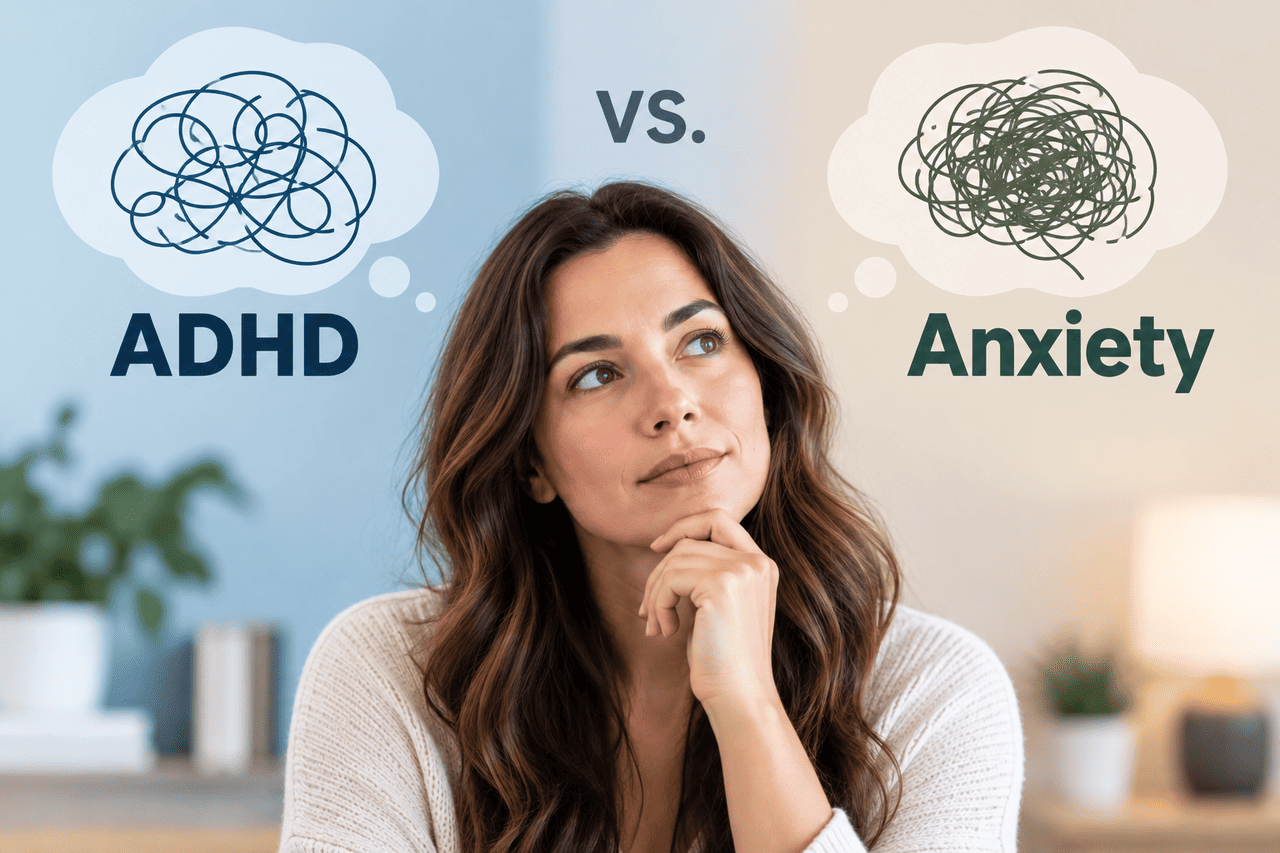
Difficulty concentrating, procrastination, restlessness, forgetfulness, and feeling overwhelmed can occur with both ADHD and anxiety.
That overlap can make it difficult to understand what is actually causing your symptoms.
Some adults seek an ADHD evaluation after years of struggling with attention and organization. Others wonder whether they have ADHD when anxiety, depression, sleep problems, or another condition may be contributing to their difficulties.
It is also possible to have ADHD and anxiety at the same time.
Understanding the differences between ADHD vs. anxiety can help you recognize when it may be time to seek a professional evaluation.
Yes. ADHD and anxiety are different conditions, but they can produce several similar symptoms.
Both may involve:
The presence of these symptoms alone cannot determine whether someone has ADHD, anxiety, or both.
A psychiatric evaluation looks at the overall pattern of symptoms, when they began, what seems to trigger them, how persistent they are, and how they affect everyday functioning.
Attention-deficit/hyperactivity disorder, or ADHD, is a neurodevelopmental disorder involving persistent patterns of inattention and/or hyperactivity and impulsivity that interfere with functioning.
Although ADHD is commonly associated with childhood, symptoms can continue into adulthood. Some people are not diagnosed until much later in life.
In adults, ADHD may affect:
Hyperactivity can also look different in adults than it does in children. Some adults experience internal restlessness, difficulty relaxing, frequent activity switching, or a persistent need for stimulation rather than obvious physical hyperactivity.
Because ADHD is a neurodevelopmental condition, an adult evaluation generally considers whether relevant symptoms were present earlier in life, even if they were not recognized as ADHD at the time.
Feeling anxious occasionally is a normal response to stressful or uncertain situations.
An anxiety disorder involves anxiety, fear, worry, or related symptoms that become persistent or significant enough to cause distress or interfere with everyday life.
Depending on the type of anxiety and the individual, symptoms may include:
Anxiety can consume a significant amount of mental attention. When your mind is repeatedly focused on potential problems or feared outcomes, concentrating on work, conversations, or other responsibilities may become difficult.
One of the most useful questions is why attention is being disrupted.
A person with ADHD may struggle to maintain attention even when they are not particularly worried or anxious. Their attention may shift toward something more interesting, stimulating, immediate, or novel.
A person experiencing anxiety may have difficulty concentrating because worry or fear repeatedly pulls attention away from the task at hand.
For example, imagine two people sitting through a work meeting.
Someone with ADHD might lose track of the discussion because their attention shifts to an unrelated thought, an email notification, something happening outside the room, or another task they suddenly remember.
Someone with anxiety might lose track of the same discussion because they are thinking about an upcoming presentation, worrying about making a mistake, or anticipating a negative outcome.
Both people appear distracted.
What is contributing to the distraction may be different.
Adult ADHD symptoms often involve persistent difficulties with executive functioning.
Someone may struggle to organize responsibilities, estimate how long tasks will take, remember appointments, prioritize work, or complete tasks that are not particularly interesting.
Common experiences can include:
These patterns generally need to be considered in the context of a person's history and functioning.
Anxiety often involves persistent worry, fear, tension, or anticipation of something going wrong.
Someone may repeatedly think about work, relationships, health, finances, family responsibilities, or situations they cannot fully control.
Anxiety-related symptoms may include:
The specific symptoms can vary depending on the type of anxiety and the individual.
ADHD-related attention difficulties are more complicated than simply being unable to concentrate.
Some adults with ADHD can focus intensely on activities they find interesting while having substantial difficulty maintaining attention during routine, repetitive, or less stimulating tasks.
They may struggle with:
This inconsistency can be confusing.
Someone may wonder how they can spend hours concentrating on something interesting but struggle to complete a relatively simple administrative task.
That pattern alone does not diagnose ADHD, but it can be relevant during an evaluation.
Anxiety can make concentration difficult because worry competes for your attention.
You may be trying to work while simultaneously thinking about a deadline, relationship problem, financial concern, health issue, or possibility of making a mistake.
Part of your attention remains focused on those concerns.
Anxiety can also interfere with sleep. Poor sleep can further affect concentration, memory, mood, and executive functioning.
As a result, someone experiencing significant anxiety may begin wondering whether their concentration problems are actually ADHD.
Procrastination can occur with both ADHD and anxiety.
With ADHD, procrastination may be related to difficulty initiating tasks, organizing the necessary steps, estimating time, maintaining motivation, or prioritizing responsibilities.
Someone may know exactly what needs to be done but still struggle to get started until the deadline becomes urgent.
With anxiety, procrastination may be more closely connected to avoidance.
A person may delay beginning because the task creates worry about failure, criticism, uncertainty, or making the wrong decision.
Sometimes both processes occur together.
Understanding why someone repeatedly postpones tasks can therefore provide useful information during an evaluation.
Restlessness is another symptom shared by both conditions.
ADHD-related restlessness in adults may involve:
Anxiety-related restlessness may feel more connected to nervousness, tension, fear, or persistent worry.
The experiences can overlap considerably, so restlessness by itself cannot distinguish ADHD from anxiety.
Adults with ADHD may frequently forget appointments, deadlines, conversations, responsibilities, or where they placed important belongings.
Anxiety can also affect memory.
When someone's attention is occupied by persistent worry, they may not fully process information in the first place. That can later feel like a memory problem.
Sleep disruption associated with anxiety may further contribute to forgetfulness and difficulty concentrating.
The pattern and context of the symptoms matter.
Anxiety can produce symptoms that resemble aspects of ADHD.
These may include concentration difficulties, restlessness, procrastination, sleep problems, forgetfulness, and feeling mentally overwhelmed.
That does not mean anxiety causes ADHD.
Instead, two different conditions can sometimes create similar outward symptoms.
This is an important reason not to assume that difficulty concentrating automatically means ADHD.
Living with persistent problems involving organization, deadlines, forgotten responsibilities, work, school, finances, or relationships can create considerable stress.
For example, someone who repeatedly misses deadlines may eventually become anxious about upcoming deadlines because previous experiences have taught them that something could go wrong.
ADHD-related impairment can therefore contribute to circumstances that generate anxiety and stress.
However, whether someone also has an anxiety disorder requires a broader clinical evaluation.
Yes.
ADHD and anxiety can occur together.
When both conditions are present, symptoms may interact. Anxiety can make concentration more difficult, while ADHD-related disorganization or forgotten responsibilities may create additional sources of stress.
This can make it particularly difficult to determine which condition is contributing to a particular symptom without looking at the broader history.
Identifying co-occurring conditions can also be important when developing an appropriate treatment plan.
Distinguishing between ADHD and anxiety can be particularly relevant for women whose ADHD symptoms were not recognized earlier in life.
Some women with ADHD experience primarily inattentive symptoms rather than obvious external hyperactivity.
These may include:
Years of compensating for these difficulties can also create stress.
However, anxiety, depression, sleep difficulties, and other conditions can produce similar symptoms. A comprehensive evaluation is important before assuming ADHD is the explanation.
ADHD and anxiety are not the only possible explanations for problems with attention, restlessness, motivation, or organization.
Similar symptoms may occur with:
More than one condition may also be present.
This is why diagnosing yourself based on a few symptoms or an online checklist can be misleading.
There is no single symptom that definitively separates ADHD from anxiety.
A psychiatric evaluation considers the broader clinical picture.
Your psychiatrist may ask about:
The timeline can be particularly useful.
If attention and organizational difficulties have been present since childhood and continue even when anxiety is minimal, ADHD may warrant consideration.
If concentration difficulties primarily occur during periods of significant worry or anxiety, another explanation may be more likely.
Real-world cases are not always that simple, especially when both conditions are present.
There is no universal answer.
Treatment depends on the individual's diagnoses, symptom severity, degree of impairment, medical history, previous treatment response, and other clinical factors.
For some people, one condition is clearly causing greater impairment.
For others, ADHD and anxiety may both need to be addressed as part of a broader treatment plan.
The goal is not simply to treat whichever diagnosis appears first. Treatment should address the individual's overall clinical needs.
Some people taking stimulant ADHD medications may experience nervousness, jitteriness, sleep difficulties, or anxiety-like symptoms.
Individual responses vary considerably.
For someone who actually has ADHD, improving attention, organization, and task completion may also reduce some of the stress associated with unmanaged ADHD symptoms.
This is one reason medication decisions should follow an appropriate evaluation and include ongoing monitoring.
ADHD medication is intended to treat ADHD, not an anxiety disorder.
Treatment should be individualized.
ADHD treatment may involve medication when appropriate, psychotherapy, behavioral strategies, organizational systems, environmental modifications, and attention to sleep and lifestyle factors.
Both stimulant and non-stimulant medications may be considered depending on the individual's circumstances.
Anxiety treatment may involve psychotherapy, medication when appropriate, behavioral interventions, and strategies addressing sleep, stress, and avoidance.
When ADHD and anxiety occur together, the treatment plan may need to account for both conditions.
Consider speaking with a healthcare professional when problems with attention, organization, anxiety, restlessness, or executive functioning persist and interfere with your daily life.
An evaluation may be particularly helpful if:
You do not need to determine whether you have ADHD or anxiety before seeking care.
Figuring out what may be contributing to your symptoms is part of the evaluation.
If you are struggling with concentration, organization, anxiety, or other symptoms that affect everyday life, a psychiatric evaluation can help clarify what may be contributing to those difficulties.
At Saltmeadow Psychiatry, Dr. Daniel Perry, MD, MPH provides individualized psychiatric evaluation, adult ADHD treatment, and medication management in Savannah, Georgia.
Rather than assuming that concentration difficulties automatically indicate ADHD, an evaluation considers your symptoms, history, functioning, medical factors, and other possible explanations.
When treatment is appropriate, recommendations are individualized based on your clinical needs.
315 Commercial Drive, Suite D-6
Savannah, GA 31406
Phone: (912) 513-2888
Request an Appointment:
https://spruce.care/danielperrymd
ADHD and anxiety can both cause concentration problems, restlessness, procrastination, and feeling overwhelmed. The history, timing, context, and underlying reasons for symptoms can help distinguish them. A professional evaluation can help determine whether ADHD, anxiety, another condition, or a combination may be contributing.
Yes. Anxiety can interfere with concentration, memory, sleep, and task completion. These difficulties can sometimes resemble ADHD symptoms.
Yes. Restlessness, difficulty managing responsibilities, chronic overwhelm, and stress associated with ADHD may sometimes resemble anxiety. ADHD and anxiety can also occur together.
Yes. A person can have both ADHD and an anxiety disorder. When both conditions are present, treatment may need to address each condition as part of an individualized plan.
People with ADHD may experience rapid thoughts or difficulty regulating attention. Persistent worry and repetitive thoughts focused on possible negative outcomes may be more closely associated with anxiety. Overthinking alone cannot determine whether someone has ADHD or anxiety.
Some people may experience nervousness, jitteriness, sleep difficulties, or anxiety-like symptoms with stimulant medication. Individual responses vary, which is why ADHD medications should be prescribed and monitored by an appropriate healthcare professional.
An appropriate clinical evaluation is important before ADHD medication is prescribed. Concentration problems have many possible causes, and treatment should be based on the individual's overall clinical picture.
Saltmeadow Psychiatry provides adult ADHD evaluation, treatment, and psychiatric medication management in Savannah, Georgia. An evaluation can help determine whether symptoms may be related to ADHD, anxiety, another condition, or a combination.
.png)
